Where Did All the VIC-20s Go After Commodore Moved On?
◆ Revised
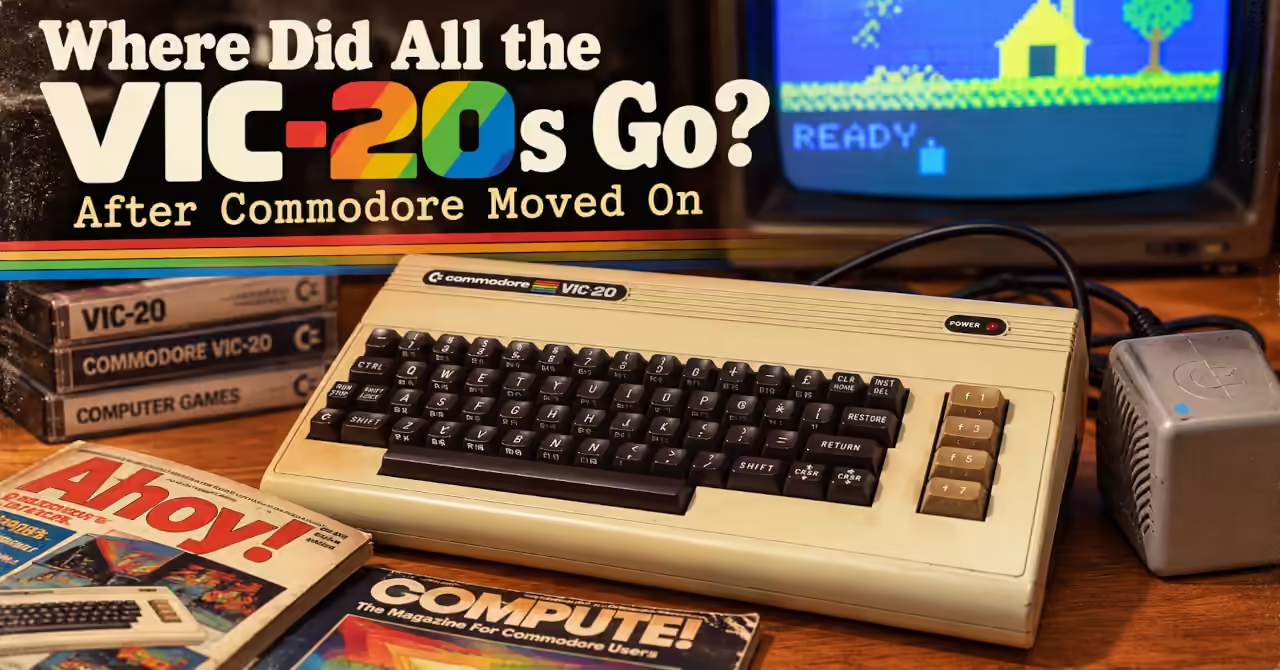
By 1986, the VIC-20 seemed to have disappeared.
Only a few years earlier it had been one of the machines that helped push home computing into the mass market. It was inexpensive, approachable and sold in enormous numbers. Then the Commodore 64 arrived, conquered the market and cast such a long shadow that its predecessor quickly began to look like yesterday's computer.
The magazines moved on. Retailers moved on. Commodore moved on. Production of the VIC-20 ended in January 1985.
Yet the machines themselves had not gone anywhere.
In January 1986, Ahoy! reported the arrival of the VIC-Talker, a new speech synthesizer for the VIC-20, and introduced it with a slightly incredulous “Believe it or not”.
That makes the question Where did all the VIC-20s go? rather more interesting than it first appears.
When the VIC-20 was the future
It is difficult to look back at early Commodore computing without the Commodore 64 dominating the view. Its enormous success has a way of pulling everything around it into the background. The VIC-20 is particularly vulnerable to this because it arrived immediately before the machine that would become one of the defining home computers of the 1980s.
But in 1981 there was no C64 casting that shadow.
The VIC-20 entered the market with a headline price of $299.95 in a Compute! advertisement, promoted as a way through the “computer price barrier”. That was not merely advertising rhetoric. Personal computers were still expensive enough to feel like specialist equipment. The VIC-20 presented something different: a computer inexpensive and friendly enough to sit beside the family television.
It became a mass-market gateway into computing. Sales passed the million-unit mark, with later accounts putting the eventual total considerably higher. For many people the VIC-20 was not a lesser computer encountered on the way to something more important. It was their first computer.
They typed BASIC programs into it. They loaded games from tape and cartridge. They experimented with graphics and sound, bought joysticks and memory expansions, and discovered that the television in the lounge room could suddenly become a programmable machine.
The VIC-20 helped make the home computer ordinary.
The beginning of the eclipse
The VIC-20's problem was not that Commodore failed to find a market for it. Quite the opposite. Commodore found the market so successfully that it was soon able to offer those customers something substantially better.
The Commodore 64 arrived in 1982 with more memory, stronger graphics, much more capable sound and considerably greater room for software developers to work. It did not merely replace the VIC-20 technically. It offered a much more persuasive picture of what home computing was going to become.
And people responded.
The C64 became the Commodore machine everyone wanted to talk about. Developers followed it. Retailers followed it. Magazines followed it. Existing VIC owners now had an obvious upgrade path sitting immediately above them in Commodore's own range.
Many must have taken it.
By 1983 the VIC-20 could already be found for less than $90, an extraordinary fall for a machine whose original attraction had itself been a low price. Commodore had built an inexpensive on-ramp to home computing and then made the next step so attractive that the on-ramp began to look temporary.
The VIC-20 was being eclipsed by its own successor.
The magazines stopped talking about it
This change was particularly visible in the computer press.
Once the C64 had established itself, it increasingly became the Commodore computer that mattered. Page space is finite, and magazines naturally concentrated on the machines attracting new buyers, new games, new software and new advertising. The VIC-20 gradually slipped towards the margins.
That can make the transition look much more abrupt in retrospect than it probably felt to the people who actually owned the machines.
A computer does not stop working because a magazine stops printing articles about it.
A child who had received a VIC-20 a year or two earlier could continue playing games on it. Someone learning BASIC could keep writing programs. Existing cartridges, cassette software and peripherals remained perfectly usable. A family upgrading to a C64 might move the VIC into another bedroom rather than throw it away. Another machine might be lent to a cousin, packed into a cupboard or placed in the attic because it still seemed too useful to discard.
Millions of computers do not simply evaporate when their manufacturer introduces something newer.
What disappeared first was not the VIC-20 itself.
It was the attention surrounding it.
So where did all the VIC-20s go?
They went under televisions, onto bedroom desks, into classrooms and eventually into cupboards, garages and attic boxes.
Some undoubtedly remained in regular use. Others became secondary computers after their owners upgraded. Some probably passed down through families as the better machine took pride of place. Others sat untouched for years before eventually reappearing in the hands of collectors.
This distinction between the survival of a computer and the survival of its commercial market is important.
The computer industry moves remarkably quickly. Advertising moves to the new machine. Software developers follow the larger market. Retail shelves are required for the next generation of products. Magazine editors devote their pages to whatever readers are most interested in buying now.
But the installed base moves much more slowly.
By the time Commodore stopped producing the VIC-20 in January 1985, a huge number of machines were already out in the world. They did not receive a message telling them that their commercial life had ended. They simply continued doing whatever their owners had been doing with them the previous day.
And that is where our small clue from 1986 becomes so interesting.
The accessory that gave it away
In January 1986, Ahoy! could still report the arrival of a new VIC-specific accessory and introduce it with a slightly incredulous “Believe it or not”.
That little editorial flourish says a remarkable amount.
A new VIC-20 accessory had become unusual enough to be surprising. The machine was clearly no longer at the centre of the market. Yet somebody still believed there were enough VIC-20 owners to justify designing, manufacturing and selling new hardware for them.
That is the point at which the disappearance story becomes something else.
The VIC-20 had not died. It had changed status.
It had moved from being a current mass-market computer to an older platform with a substantial installed base. New software was still trickling out. Hardware expansions were still appearing. Owners were still using the machines. What had vanished was the assumption that the VIC-20 represented the future.
The future belonged to the C64.
But the VIC-20 still had a present.
A computer can survive outside the spotlight
This is perhaps the most interesting part of the VIC-20 story because it is easy to lose when looking backwards through magazine covers and sales charts.
History tends to remember the winners at the moment of their greatest visibility. The C64 deservedly occupies an enormous place in the history of home computing. It accumulated a vast software library, a huge user base and an extraordinary cultural presence.
Yet that success also obscures what came immediately before it.
The VIC-20 had already done much of the difficult work. It helped persuade ordinary households that a computer could be affordable, approachable and useful. It introduced large numbers of people to programming and computer games. It established Commodore in homes that might previously have regarded computers as expensive machines belonging in offices, laboratories or the rooms of unusually dedicated hobbyists.
Then those customers were offered a Commodore 64.
In that sense the VIC-20 was partly cannibalised by its own success. Commodore had created the inexpensive entry point, built a huge audience and then produced a machine capable of taking that audience much further.
The VIC-20 did not fail to create a future.
It helped create the future that overshadowed it.
And then something even stranger happened
If the story ended in 1986, the VIC-20 would already have enjoyed an unusually persistent afterlife. It had been discontinued, displaced by a vastly more successful successor and pushed towards the margins of the computer press, yet people were still producing new things for it.
But the story did not end there.
Decades later the VIC-20 remains an active retrocomputing platform. Enthusiasts continue developing hardware that would have seemed extraordinary when the computer was new. Modern storage interfaces make enormous libraries of software accessible without relying on ageing cassette tapes or floppy disks. New cartridges combine functions that once required several separate peripherals. Memory expansions can give the little VIC amounts of working space wildly beyond the 5K machine that first appeared in 1981.
That is an extraordinary fate for a computer that appeared to have been swept aside before the middle of the 1980s.
The original engineers could reasonably have expected VIC-20s to remain usable for some years. They could hardly have designed the machine on the assumption that people would still be expanding, programming and discussing it more than four decades later.
Yet here we are.
The VIC-20 was the unsung hero
The Commodore 64 conquered the home-computer world, and its reputation is thoroughly deserved. But its enormous success has had an unintended consequence: it has made the VIC-20 easy to underestimate.
The VIC was not merely an inferior C64 waiting to be replaced.
It was one of the machines that helped establish the conditions in which the C64 could become such a phenomenon. It lowered the price of entry. It put computers beside ordinary television sets. It introduced first-time owners to BASIC, games and computer peripherals. It helped transform the home computer from an exotic purchase into a plausible household possession.
And when the C64 took over, the VIC did not disappear.
Some owners upgraded and put the old machine away. Others continued using it. Software continued to appear. New hardware continued to be made. The visible market became smaller, but beneath that shrinking public profile remained a population of machines and owners that proved remarkably difficult to extinguish.
In 1986, Ahoy! found the appearance of a new VIC-20 peripheral sufficiently unexpected to remark upon it.
More than forty years after the VIC-20 first appeared, people are still designing new hardware for it.
Consider the modern Penultimate+3dcr cartridge. It can equip a VIC-20 with up to 280K of banked RAM, more than 230 ROM programs, SD-card mass storage and fast loading—all through a machine whose original specification included just 5K of RAM.
So perhaps the answer to Where did all the VIC-20s go? is simpler than expected.
They never really went away. The VIC-20 deserves to be judged on its own terms.
Writer's Notes
Reader Guide
The following material expands on the terminology, historical context, technical concepts, and related reading connected to this article.
Glossary
Some of the terms used in this article have specialised, historical or technical meanings. This glossary provides additional context for selected terms and ideas.
- VIC-20
- A low-cost home computer Commodore launched into the consumer market in 1981; designed to plug into a household television and include an easy-to-use BASIC interpreter, it sold in the millions as a mass-market “gateway” device that taught many first-time buyers to program and formed a large, long-lived installed base.
- Commodore 64 (C64)
- The 1982 successor to the VIC-20, notable for substantially more memory and markedly better graphics and sound; its stronger software ecosystem and technical headroom made it the company’s new flagship and shifted retailer, developer and magazine attention away from the older VIC-20.
- installed base
- The pool of existing owners who already possess a product; a large installed base can keep demand for accessories, repairs and niche software alive long after new-unit sales decline, because manufacturers and third parties still have a ready audience to serve.
- BASIC
- A simple, interpreted programming language commonly built into 8-bit home computers; its presence on machines like the VIC-20 lowered the barrier to writing programs and learning computing, which helped those machines remain useful in homes and schools even after mainstream attention moved on.
- cannibalization
- A business process whereby a company’s new product takes sales, attention or resources away from its older product lines; this internal displacement can be a deliberate strategy to move customers up the value chain, leaving the earlier product useful but commercially peripheral.
Frequently asked questions
Curious about something you’ve just read? These frequently asked questions explore some of the key ideas, details and questions surrounding the topic.
Why did the VIC-20 stop being visible in the market by 1986?
Commodore shifted attention and resources to the more capable Commodore 64, production ended in January 1985, prices dropped sharply, and the surrounding ecosystem of new software, advertising, and retail focus moved on, leaving the VIC-20 physically present but commercially peripheral.
How successful was the VIC-20 when it was introduced?
Introduced in 1981 at about $299.95 as an affordable home computer, it became a mass-market gateway with lifetime sales reported between roughly one million and 2.5 million units and helped teach hundreds of thousands of consumers to program.
What role did the Commodore 64 play in the VIC-20's decline?
The C64 offered more memory, better graphics and sound, and a stronger software story, so it attracted dealer and consumer attention and effectively absorbed the market that the VIC-20 had helped create, making the older machine peripheral rather than a flagship.
Where did all the VIC-20s actually go after they fell out of the spotlight?
Many remained in homes, schools, closets, drawers, and attics where they were still usable for BASIC, cartridges, and simple peripherals, while others sat in storage until collectors and retrocomputing enthusiasts rediscovered them.
Related articles…
References and Further Reading
- Commodore.ca, Commodore VIC-20 History & Time Line. Used for the January 1985 production stop and Commodore’s own retrospective framing of the machine’s commercial life.
- York University Computer Museum, Commodore VIC-20. Used for historical summary, sales context, and the million-unit milestone.
- Ahoy! Magazine, January 1986 issue, Speech Synthesizers for the Commodore Computers, Part II. Used for the “Believe it or not, a new VIC accessory” evidence.
- Compute! Magazine advertisement, July 1981, Commodore breaks the computer price barrier — $299.95. Used for the VIC-20’s launch positioning as an inexpensive entry computer.
Disclosure
This article was prepared using a combination of original research, published sources, archival material, and digital research and writing tools, including the use of large language model tools. Sources are referenced where appropriate. The author reviews and edits the article and may make ongoing editorial updates. Any commercial relationships, affiliate links, sponsorships, or other material interests relevant to the article are disclosed separately where applicable.